When Boomers Pass, Their Low Rates Go With Them
August 4, 2026
When Boomers Pass, Their Low Rates Go With Them
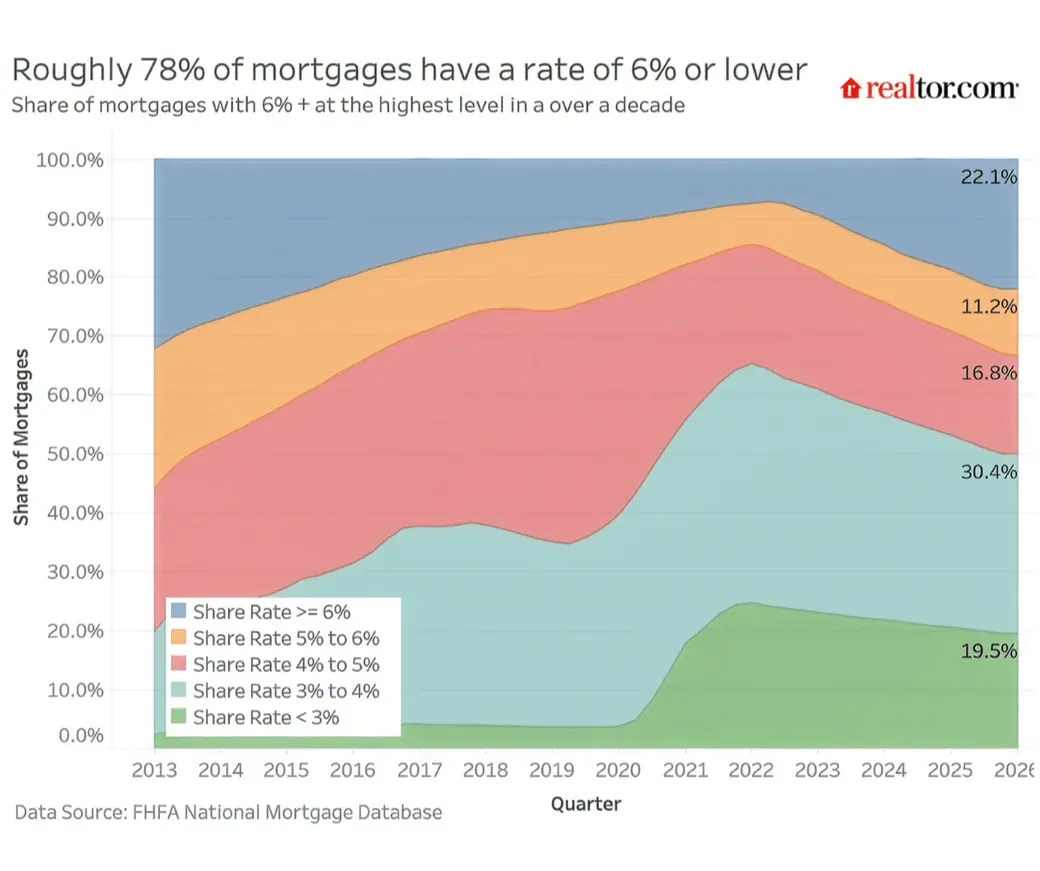
There is a number that does not get talked about enough in real estate right now: 78%.
That is the share of American homeowners who currently hold mortgages at a rate of 6% or lower. Nearly 4 out of 5 homeowners are sitting on a rate better than what any buyer can get today, and a large portion of them are Baby Boomers.
This is a significant factor shaping the housing market right now, because when those homeowners eventually pass, their heirs do not inherit the mortgage. They inherit the equity. That distinction has real consequences for inventory, pricing, and who gets to buy a home over the next decade.
The Rate Lock-In Effect in Numbers
According to the FHFA National Mortgage Database, here is how existing mortgages break down today:
- 19.5% of mortgages are below 3% -- the pandemic-era lows
- 30.4% are in the 3% to 4% range
- 16.8% sit between 4% and 5%
- 11.2% are in the 5% to 6% range
- Only 22.1% are at 6% or higher, which is today's going rate
Nearly 50% of all active mortgages were locked in below 4%. Those are rates that are not coming back, and the homeowners holding them have very little financial reason to sell. This is what analysts call the "rate lock-in effect," and it is one of the primary reasons housing inventory has been so constrained.
Why Boomers Hold the Key
Baby Boomers are the largest generation of homeowners in the country. Many locked in rates during the historic lows of 2020 and 2021, and others have owned their homes long enough that their mortgage balance is nearly paid off. Either way, they are not in a hurry to move.
Trading a 3% mortgage for a 6.82% loan on a smaller home does not pencil out for most people. So they stay, inventory stays tight, and buyers continue competing for whatever limited supply hits the market.
What changes this picture is generational wealth transfer. Mortgages do not pass from parents to children the way a home or savings account can. When a homeowner dies, the mortgage must be settled.
What Heirs Actually Inherit
The "due-on-sale" clause in virtually every modern mortgage means the loan cannot simply be handed off to an heir. When a homeowner passes, the family typically faces one of three options:
- Sell the home. The mortgage gets paid off from the proceeds, and the property enters the market as new inventory.
- Refinance and keep it. The heir takes on a new loan at today's rates, which changes the monthly cost significantly.
- Pay cash to retain it. This works for some estates, but it is not realistic for most families.
In any of those scenarios, that sub-4% mortgage is gone permanently. The low-rate advantage that kept the original owner in place does not carry forward.
What This Means Over the Next Decade
This is not a sudden shift. It will play out gradually over 10 to 20 years as the Boomer generation ages. But the volume of homes that will move through estates during that period is substantial, and it represents a slow but meaningful release of inventory that the market badly needs.
For buyers frustrated by limited options, this is reason for patience rather than panic. The inventory crunch is tied to demographics more than anything else, and demographics follow a predictable timeline.
For sellers who are currently in the 5% to 6% rate range and considering a move, right now may be a good window. You are still well positioned compared to buyers who need to finance at today's rates, and a well-priced home in this market still moves.
What to Do With This Information
If you are a buyer, the best strategy is to focus on what you can afford today, build equity, and plan to refinance when rates eventually come down. Waiting for inventory to improve or rates to drop simultaneously is a long game with no guaranteed timeline.
If you are managing an estate or helping a family member think through a home they have inherited, understanding the mortgage situation early makes the decision process much cleaner. Whether the right move is to sell, refinance, or hold depends on the numbers specific to that property.
And if you are a Boomer who is thinking about whether to sell now or leave the decision to your heirs, that is a conversation worth having with someone who knows your local market well.
Feel free to reach out. I am happy to help you think through the options.
Data Source: FHFA National Mortgage Database via Realtor.com
Nearly 50% of all active mortgages were locked in below 4%. Those are rates that are not coming back, and the homeowners holding them have very little financial reason to sell. This is what analysts call the "rate lock-in effect," and it is one of the primary reasons housing inventory has been so constrained.
Why Boomers Hold the Key
Baby Boomers are the largest generation of homeowners in the country. Many locked in rates during the historic lows of 2020 and 2021, and others have owned their homes long enough that their mortgage balance is nearly paid off. Either way, they are not in a hurry to move.
Trading a 3% mortgage for a 6.82% loan on a smaller home does not pencil out for most people. So they stay, inventory stays tight, and buyers continue competing for whatever limited supply hits the market.
What changes this picture is generational wealth transfer. Mortgages do not pass from parents to children the way a home or savings account can. When a homeowner dies, the mortgage must be settled.
What Heirs Actually Inherit
The "due-on-sale" clause in virtually every modern mortgage means the loan cannot simply be handed off to an heir. When a homeowner passes, the family typically faces one of three options:
- Sell the home. The mortgage gets paid off from the proceeds, and the property enters the market as new inventory.
- Refinance and keep it. The heir takes on a new loan at today's rates, which changes the monthly cost significantly.
- Pay cash to retain it. This works for some estates, but it is not realistic for most families.
In any of those scenarios, that sub-4% mortgage is gone permanently. The low-rate advantage that kept the original owner in place does not carry forward.
What This Means Over the Next Decade
This is not a sudden shift. It will play out gradually over 10 to 20 years as the Boomer generation ages. But the volume of homes that will move through estates during that period is substantial, and it represents a slow but meaningful release of inventory that the market badly needs.
For buyers frustrated by limited options, this is reason for patience rather than panic. The inventory crunch is tied to demographics more than anything else, and demographics follow a predictable timeline.
For sellers who are currently in the 5% to 6% rate range and considering a move, right now may be a good window. You are still well positioned compared to buyers who need to finance at today's rates, and a well-priced home in this market still moves.
What to Do With This Information
If you are a buyer, the best strategy is to focus on what you can afford today, build equity, and plan to refinance when rates eventually come down. Waiting for inventory to improve or rates to drop simultaneously is a long game with no guaranteed timeline.
If you are managing an estate or helping a family member think through a home they have inherited, understanding the mortgage situation early makes the decision process much cleaner. Whether the right move is to sell, refinance, or hold depends on the numbers specific to that property.
And if you are a Boomer who is thinking about whether to sell now or leave the decision to your heirs, that is a conversation worth having with someone who knows your local market well.
Feel free to reach out. I am happy to help you think through the options.
Data Source: FHFA National Mortgage Database via Realtor.com
Categories
Recent Posts